
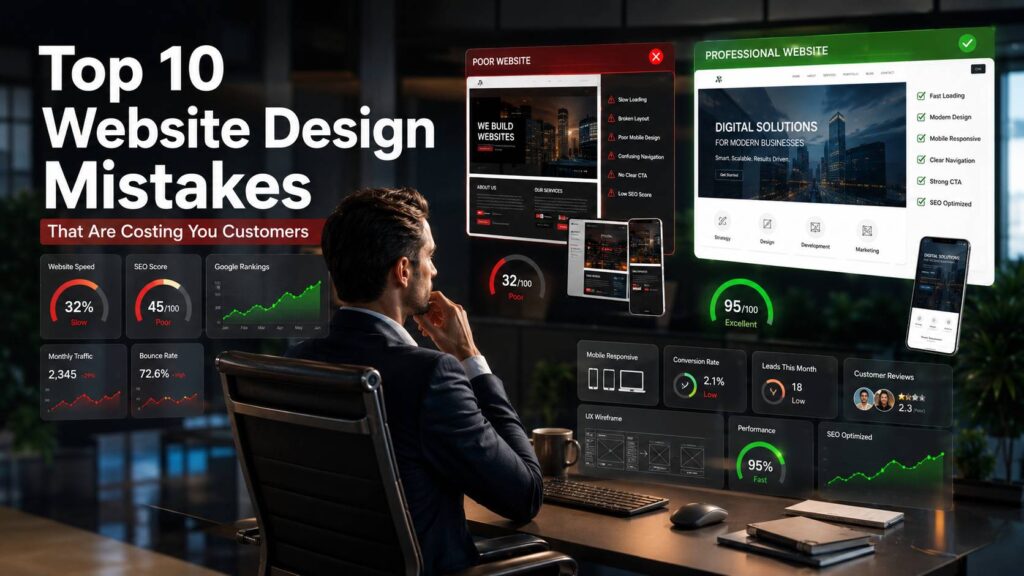
A business website should do more than just look attractive. It should create trust, provide a smooth user experience, and encourage visitors to contact your business. Unfortunately, many websites fail to achieve these goals because of simple design mistakes that often go unnoticed.
A visitor forms an opinion about a website within a few seconds. If the website is slow, confusing, outdated, or difficult to use, most people leave without exploring further. Every visitor who leaves your website without taking action could be a lost customer.
The good news is that most website design mistakes are easy to identify and fix. Once these issues are resolved, your website becomes more user-friendly, performs better on search engines, and generates more enquiries.
In this guide, we’ll discuss the most common website design mistakes that prevent businesses from converting visitors into customers and explain how to avoid them.
Why Website Design Matters More Than Ever
A website is often the first interaction a customer has with your business. Before making a phone call, filling out an enquiry form, or purchasing a product, people usually visit your website to learn more about your company.
A professional website creates confidence. It helps visitors understand your services, builds credibility, and makes it easier for them to take the next step.
A poorly designed website has the opposite effect. Visitors may question the quality of your business before they even contact you.
Good website design is no longer just about attractive colours or beautiful layouts. It combines user experience, speed, accessibility, mobile responsiveness, and search engine optimization to create a website that supports business growth.
Mistake #1 – Slow Website Loading Speed
Website speed is one of the most important factors affecting both user experience and search engine rankings.
Most visitors expect a website to load quickly. If a page takes too long to open, many users simply leave and visit a competitor’s website instead.
Slow websites also reduce customer trust and increase bounce rates.
Common reasons for slow websites include:
- Large unoptimized images
- Too many plugins
- Poor hosting quality
- Heavy animations
- Unnecessary JavaScript files
- Unoptimized CSS files
Improving website speed not only creates a better experience for visitors but also supports better SEO performance and higher conversion rates.
Mistake #2 – Poor Mobile Responsiveness
Today, a large percentage of website visitors browse using smartphones and tablets.
If your website does not display properly on mobile devices, visitors may struggle to read content, click buttons, or navigate through pages.
A mobile-friendly website automatically adjusts to different screen sizes, making it easier for users to browse comfortably.
Some common mobile design problems include:
- Small text
- Buttons placed too close together
- Images extending beyond the screen
- Horizontal scrolling
- Broken layouts
- Difficult navigation
A responsive website provides a better experience for every visitor, regardless of the device they use.
Mistake #3 – Confusing Navigation
Visitors should never have to guess where to click next.
A website with complicated menus, too many navigation options, or unclear page names creates frustration and encourages users to leave.
Good navigation should be simple, organized, and easy to understand.
Your main menu should guide visitors to important pages such as:
- Home
- About Us
- Services
- Portfolio
- Blog
- Contact
Keeping navigation clean helps visitors find information quickly and improves overall user experience.
Mistake #4 – Weak Call-to-Action (CTA)
Many websites provide useful information but fail to tell visitors what they should do next.
After reading your content, users should clearly understand the next action.
Examples of effective calls-to-action include:
- Request a Free Quote
- Book a Consultation
- Contact Our Team
- Call Now
- Get Started Today
- Send an Enquiry
Your CTA buttons should be easy to find, visually attractive, and placed naturally throughout the website instead of appearing only on the contact page.
Mistake #5 – Outdated Website Design
A website represents your business online. If the design looks outdated, visitors may assume your products or services are also outdated.
An old-fashioned website can reduce trust even before a customer reads your content.
Some signs of an outdated website include:
- Old color combinations
- Small fonts
- Poor spacing
- Flashy animations
- Low-quality images
- Cluttered layouts
A modern website should look clean, professional, and easy to navigate. A fresh design not only improves user experience but also creates a stronger first impression.
Mistake #6 – Low-Quality Content
Many businesses spend money on website design but ignore the quality of their content.
Visitors don’t just look at your design—they also read your content before making a decision.
Content should answer real customer questions, explain your services clearly, and help visitors understand why they should choose your business.
Avoid:
- Copying content from other websites
- Keyword stuffing
- Very short paragraphs
- Grammatical mistakes
- Technical language that customers don’t understand
Simple, helpful, and well-structured content always performs better.
Mistake #7 – No Trust Signals
Customers prefer businesses they can trust.
If your website doesn’t show proof that your business is genuine, visitors may hesitate to contact you.
Trust signals can include:
- Customer Reviews
- Testimonials
- Business Address
- Phone Number
- Email Address
- Google Business Profile
- Portfolio
- Years of Experience
- Client Logos
- Secure HTTPS Connection
These small details make a big difference in building confidence.
Mistake #8 – Poor Contact Experience
Many websites hide their contact information or make it difficult for visitors to reach them.
A customer should never spend several minutes searching for your phone number or enquiry form.
Your contact options should be available throughout the website.
Useful contact methods include:
- Contact Form
- WhatsApp Button
- Click-to-Call Button
- Email Address
- Business Address
- Google Maps Location
The easier it is to contact your business, the higher your chances of receiving enquiries.
Mistake #9 – Ignoring SEO During Website Design
A beautiful website alone cannot attract visitors if search engines cannot understand it.
SEO should be considered from the very beginning of website development.
Important SEO elements include:
- Proper Heading Structure
- Optimized Images
- Fast Loading Speed
- Mobile Responsiveness
- Internal Linking
- SEO-Friendly URLs
- Meta Titles
- Meta Descriptions
- Schema Markup
When SEO is included during the design process, your website has a stronger foundation for future rankings.
Mistake #10 – Not Updating the Website Regularly
A website should never remain unchanged for years.
Regular updates show both visitors and search engines that your business is active.
Updating your website can include:
- Publishing blog articles
- Adding new services
- Updating portfolio projects
- Improving existing content
- Uploading recent testimonials
- Updating contact information
- Improving page speed
- Refreshing images
Consistent updates help maintain better user engagement and improve long-term SEO performance.
Expert Tips to Build a High-Converting Website
If you want your website to generate more enquiries and improve customer trust, follow these best practices:
- Keep the design clean and professional.
- Focus on fast loading speed.
- Make every page mobile-friendly.
- Use clear headings and simple language.
- Add strong call-to-action buttons.
- Display customer reviews and testimonials.
- Keep contact information visible.
- Invest in SEO from the beginning.
- Regularly update your website with fresh content.
- Continuously improve user experience based on customer feedback.
A successful website is not just visually attractive—it is designed to help visitors take action and become customers.
Frequently Asked Questions
Why is website design important for business success?
Website design creates the first impression of your business. A professional, fast, and user-friendly website helps build customer trust, improves user experience, supports better search engine rankings, and increases the chances of converting visitors into paying customers. A well-designed website works as your digital sales representative and helps your business grow online.
How often should a business redesign its website?
Most businesses should review and refresh their website every two to three years or whenever their services, branding, or customer expectations change. Regular improvements help maintain a modern appearance, improve security, enhance performance, and keep the website aligned with current design trends and SEO best practices.
Can poor website design affect SEO rankings?
Yes. Website design directly impacts search engine optimization. Slow loading speed, poor mobile responsiveness, confusing navigation, broken links, and weak user experience can reduce search rankings. A properly designed website improves technical SEO, user engagement, and overall website performance, making it easier for search engines to rank your pages.
What are the signs that my website needs improvement?
Some common signs include slow loading pages, outdated design, low enquiry rates, poor mobile experience, high bounce rates, confusing navigation, broken links, and declining search engine visibility. Updating these areas can improve customer experience and help your website generate more qualified leads.
How can IARROT Digital help improve my website?
IARROT Digital specializes in professional website design, website redesign, WordPress development, SEO optimization, speed improvement, mobile responsiveness, and conversion-focused website solutions. Our team creates modern, high-performing websites that help businesses strengthen their online presence and generate measurable business growth.
Key Takeaways
Before launching or redesigning your website, remember these important points:
- Website speed directly affects user experience and SEO.
- Mobile-friendly design is essential for modern businesses.
- Clear navigation improves customer engagement.
- Strong call-to-action buttons increase conversions.
- Helpful content builds trust and authority.
- Trust signals encourage customers to contact your business.
- SEO should be integrated during website development.
- Regular website updates improve long-term performance.
Small improvements across these areas can make a significant difference in how your website performs.
Conclusion
A professional website is one of the most valuable business assets you can own. Even small design mistakes can reduce customer trust, increase bounce rates, and cost your business valuable enquiries.
The good news is that most website problems can be fixed with proper planning, better user experience, quality content, and SEO-friendly development.
Your website should not only look professional—it should help visitors understand your business, trust your brand, and take action. Businesses that continuously improve their websites are more likely to attract qualified leads, build stronger customer relationships, and achieve sustainable online growth.
Investing in a high-quality website today will continue delivering value for your business for years to come.
Ready to Build a High-Performing Business Website?
Whether you need a brand-new website, a complete redesign, or improvements to your existing website, IARROT Digital is ready to help.
We create modern, responsive, SEO-friendly, and conversion-focused websites that help businesses increase online visibility, generate qualified leads, and deliver exceptional user experiences.
Contact IARROT Digital today and let us build a website that supports your business growth and creates lasting results.